Blog Post #2
Backward Design
One concept from module 2 that stood out to me was Backward Design or Understanding by Design. Having end goals in mind it helps learners understand what they should be walking away with, which helps intentionally shape activities and assessments (Bowen, 2017). In one of my health informatics courses we were assigned a final project of designing a mock clinical information system. The instructor supported backwards design because she outlined from the beginning that the assessment would be judged on usability, security, and alignment with standards, it was easier to prioritize learning tasks and make connections between lectures and the project. Having clarity ahead of time on how it would be assessed made it less overwhelming since we understood exactly what skills and knowledge we were expected to demonstrate.
Design Thinking
Design thinking was another topic that stood out to me because of its emphasis on empathy and iteration. This framework supports flexible learning and a more evolving process rather than a linear one. For example when I was in a group project responsible for developing a health education tool on tableau, initially we created something that was to text heavy. After testing out our tool with peers we realized it wasn’t engaging or accessible to users so we redesigned it with visuals and simplified the language. By empathizing with our users and being open to change and iteration, the solution became more effective. The process we followed mirrored design thinking, where prototyping and feedback loops help increase success. Below is a short video that captures this process of design thinking and help show me how it can apply to both the classroom and the real-world contexts.
Learning Outcomes and Blooms Taxonomy
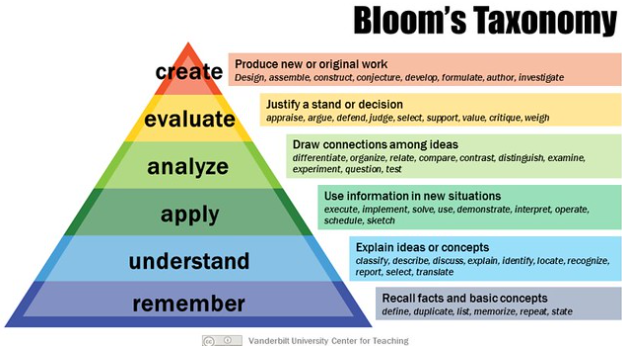
In 1956, Benjamin Bloom and colleagues first introduced their Taxonomy of Educational Objectives, a framework that categorized learning into six major levels ranging from knowledge to evaluation (Armstrong, 2010). This model was revised (2001) decades later to highlight more dynamic, action-oriented processes (Armstrong, 2010). When thinking about learning outcomes, I find Bloom’s Taxonomy very useful because of its action-oriented verbs that clearly show the levels of knowledge. For example, a weak outcome in my courses might be “students will understand databases,” which is both vague and difficult to measure. A stronger outcome would be “students will be able to design and query a simple database,” because it shows both application and measurable skills. Bloom’s framework is a good tool to ensure outcomes align with assessments, avoiding surface-level tasks and encouraging learning. The visual pyramid above shows how Bloom’s levels build from remembering at the base to creating at the top, which reminds me to think carefully about how tasks promote deeper learning.
Difference Between Surface and Deep Learning
The difference between surface and deep learning is something I have experienced firsthand. In one statistics class, I focused on memorizing formulas without truly grasping the reasoning behind them. As a result, I struggled to apply the concepts in real-world problems, which was clearly surface learning. On the other hand one time I experienced deep learning during an assignment where I was tasked to write a paper analyzing opioid prescribing patterns in British Columbia. Instead of just memorizing statistics, I had to interpret the data, connect it to health trends, and think critically about both the social and clinical implications. In this paper I got the oppertunity to go beyond surface learning because I wasn’t only recalling information but I was applying knowledge, drawing connections, and considering how the findings could be used in real decision-making.
Inquiry and Project-based Learning

Research shows that project-based and inquiry-based learning are effective teaching methods that help students build deeper understanding, think more critically, and enhance problem-solving skills (Panasan & Nuangchalerm, 2010). In health informatics, I’ve already seen how solving problems often means working with others, asking questions, and coming up with creative solutions. For example, in one class project we had to design a mock electronic health record system, and there wasn’t just one “right” way to complete it. We had to make choices about things like usability, security, and data standards, and that pushed us to think critically. Projects like that are more engaging because they feel relevant and meaningful. The downside is that open-ended tasks can often feel overwhelming.
References
Armstrong, P. (2010). Bloom’s taxonomy. Vanderbilt University Center for Teaching. https://cft.vanderbilt.edu/guides-sub-pages/blooms-taxonomy/
Bowen, R. S. (2017). Understanding by design. Vanderbilt University Center for Teaching. https://cft.vanderbilt.edu/guides-sub-pages/understanding-by-design/
Graham, S. (2016). Person holding pencil near laptop computer [Photograph]. Unsplash. https://unsplash.com/photos/amstram
Panasan, M., & Nuangchalerm, P. (2010). Learning outcomes of project-based and inquiry-based learning activities. Journal of Social Sciences, 6(2), 252–255. https://doi.org/10.3844/jssp.2010.252.255
Sprouts. (2017). The design thinking process [Video]. YouTube. https://www.youtube.com/watch?v=_r0VX-aU_T8